A peer-reviewed study published in Sleep and Breathing (2025) puts the DormoTech Vlab head-to-head against attended in-laboratory polysomnography — and the results speak for themselves.
Read the full publication: Fox et al., Sleep and Breathing (2025)
Background & Clinical Need
In-laboratory polysomnography remains the diagnostic reference standard for sleep-disordered breathing, yet its clinical utility is constrained by high costs, patient inconvenience, and an artificial sleep environment that may not reflect true physiological patterns. There is a growng need for validated, comprehensive alternatives that preserve full PSG-grade signal quality — ideally in the patient’s own home.
Study Design & Methodology
In a prospective, comparative observational trial, 47 adult participants underwent simultaneous overnight recording with both the DormoTech Vlab and the Nox A1 PSG system across two clinical sites. All recordings were independently and manually scored according to AASM guidelines. Agreement was assessed using Bland-Altman analysis, Passing-Bablok regression, Pearson’s correlation, and Cohen’s kappa coefficient.
Primary & Secondary Outcomes
The primary endpoint — apnea-hypopnea index (AHI) — showed no statistically significant difference between the two devices (Vlab: 21.7 ± 24.2 vs. Nox A1: 21.5 ± 23.9 events/hour; p=0.7). Severity classification agreement reached 97% (Cohen’s kappa = 0.97), with only 1 out of 41 participants categorized differently between the two systems. Secondary parameters including total sleep time, sleep efficiency, oxygen desaturation index (ODI), sleep stages, and body position demonstrated consistently high agreement across all statistical analyses. No adverse events were recorded.
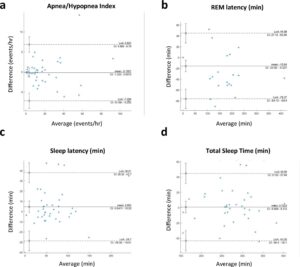
Figure 2 presents Bland-Altman plots comparing the DormoTech Vlab and gold-standard Nox A1 PSG across four key sleep parameters. For the primary endpoint (AHI), the mean difference was negligible at −0.19 events/hour, with tight limits of agreement (LoA: −7.2 to 6.8), confirming near-perfect concordance between the two systems. Similarly, sleep latency and total sleep time showed minimal systematic bias. REM latency demonstrated wider limits of agreement, reflecting the known challenges of manual REM sleep scoring rather than a device-related limitation.
Usability & Patient-Reported Outcomes
Participant-completed questionnaires administered before and after the sleep study demonstrated high satisfaction with device comfort, stability, and ease of setup, with mean Likert scores of 4.29–4.42 out of 5. Over 88% of responses across all usability questions met or exceeded the predefined acceptability threshold.
Clinical Implications
These findings support the substantial equivalence of the DormoTech Vlab to reference-standard PSG in both diagnostic accuracy and comprehensive signal acquisition. The device’s fully wireless architecture and sub-minute self-application protocol position it as a viable platform for unsupervised, home-based Type II sleep studies — expanding patient access to clinician-grade sleep diagnostics without the burden of an overnight laboratory visit.
Fox BD, Shihab M, Nassir A, Kushinsky D, Barnea O, Tal A. Validation of a novel mask-based device for monitoring of comprehensive sleep parameters and sleep disordered breathing. Sleep Breath. 2025;29:83.