

Can complex breathing patterns like Cheyne–Stokes Breathing be identified automatically at home? Discover how DormoVision X™ combines comprehensive home sleep monitoring with advanced signal analysis to detect and characterize this clinically important pattern of ventilatory instability.
Dr. Saar Lanir-Azaria¹ and Prof. Ofer Barnea²
1 Dormotech Medical 2 Tel Aviv University
Introduction
Cheyne-Stokes Breathing (CSB) is a distinctive manifestation of central sleep apnea (CSA), characterized by a cyclical waxing and waning pattern of ventilation culminating in central apneas or hypopneas. This stereotyped oscillation in respiratory drive reflects an underlying instability in the ventilatory control system, driven by enhanced chemosensitivity, delayed circulatory time, and diminished buffering capacity (Cherniack & Longobardo, 1974; Xie et al., 2002). The pathophysiological framework of CSB is grounded in periodic fluctuations of arterial carbon dioxide (PaCO₂) around the apneic threshold, which produce alternating phases of hyperventilation and apnea (Eckert et al., 2007; Terziyski & Draganova, 2018).
CSB is most commonly observed in patients with systolic heart failure, with prevalence estimates ranging from 15% to 40%, particularly in those with reduced left ventricular ejection fraction (Javaheri, 2006; Ferrier et al., 2005). Beyond its physiological peculiarities, CSB has emerged as a powerful predictor of adverse outcomes, including increased cardiovascular mortality, arrhythmogenesis, and poor quality of life (Corra et al., 2006; Javaheri et al., 2007). The interdependence between CSB and heart failure is thought to be bidirectional: the ventilatory instability exacerbates nocturnal sympathetic surges and intermittent hypoxia, further burdening myocardial function (Terziyski & Draganova, 2018).
Therapeutic approaches to CSB remain a subject of ongoing debate. While continuous positive airway pressure (CPAP) can attenuate CSA in some patients, randomized trials failed to show survival benefit (Bradley et al., 2005; Arzt et al., 2007). In light of the limitations of device-based therapy, pharmacologic alternatives such as acetazolamide have garnered interest. Acetazolamide-a carbonic anhydrase inhibitor-induces metabolic acidosis, thereby lowering the apneic threshold and enhancing respiratory drive stability (Javaheri, 2006; DeBacker et al., 1995). Moreover, it exerts mild diuretic effects, potentially alleviating pulmonary congestion and improving cardiovascular status (Schmickl et al., 2020; Fontana et al., 2011). However, despite the critical need to identify patients with CSB, its implementation in real-world clinical settings has remained limited.
In this report, we present a practical analysis of a single-night sleep study conducted in the patient’s home using the DormoVision Type 2 sleep recording system. The recording revealed hallmark features of Cheyne-Stokes Breathing, which were automatically identified using advanced signal processing tools applied to airflow and respiratory effort channels. This example underscores the translational potential of home-based, automated CSB detection in enhancing diagnostic precision and supporting individualized management strategies in real-world settings.
Case Illustration
Continuous airflow signals sampled at 25 Hz were preprocessed through a multi-stage nonlinear filtering chain to extract slow oscillatory components. Autocorrelation-based spectral analysis was then applied in 400-second windows, yielding high-resolution spectra across 0-2.5 Hz. Periodic clusters of power corresponding to waxing-and-waning ventilation cycles were automatically flagged as CSB.
Figure 1 illustrates the output of the automated detection pipeline. The top panel shows the filtered airflow trace, highlighting the waxing-and-waning ventilatory pattern culminating in central apneas. The lower panel displays the corresponding autocorrelation-derived spectrogram, in which repetitive bursts of low-frequency power align with the cyclical respiratory pattern. This combination of time-domain and frequency-domain analyses provides an intuitive visualization of the automated classification process.
This case study demonstrates the feasibility of fully automated identification of Cheyne-Stokes Breathing from Dormotech home-based sleep recordings. The signal processing framework combines time-domain pattern extraction with autocorrelation-derived spectral features, enabling reliable recognition of cyclical ventilatory instability without manual inspection.
Clinically, the implications are substantial. CSB is an independent predictor of adverse cardiovascular outcomes, including arrhythmia, hospitalizations, and mortality in patients with heart failure (Corra et al., 2006; Javaheri et al., 2007; Sorokina et al., 2022). Early, automated detection could support precision risk stratification and guide timely interventions. Such tools may also enhance monitoring of pharmacologic responses, such as acetazolamide, which has shown efficacy in attenuating central apnea severity (DeBacker et al., 1995; Javaheri, 2006; Schmickl et al., 2020).
Ultimately, the integration of automated CSB detection into home-based monitoring platforms offers a scalable means of identifying high-risk patients, facilitating earlier intervention, and potentially improving cardiovascular prognosis in populations burdened by chronic heart failure.
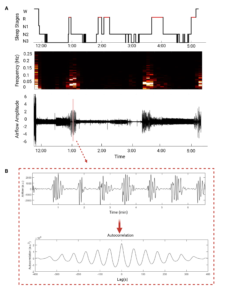
Figure 1. Automated detection of Cheyne–Stokes Breathing (CSB) from home-based sleep monitoring. (A) Overnight sleep recording obtained with the DormoVision system. Top panel: sleep stage hypnogram (W = wake; R = REM; N1–N3 = non-REM stages). Middle panel: autocorrelation-derived spectrogram of the airflow signal, showing recurrent clusters of low-frequency power corresponding to periodic breathing cycles. Bottom panel: airflow trace with a representative CSB segment (highlighted in red) selected for detailed demonstration. (B) Expanded view of the highlighted segment. Top panel: airflow signal exhibiting the classical Cheyne–Stokes pattern, characterized by crescendo–decrescendo ventilation followed by central apneas. Bottom panel: autocorrelation of the airflow segment, demonstrating a clear oscillatory structure at the CSB cycle length, confirming the periodic nature of the ventilatory instability.
Conclusion
This report highlights the capacity of automated signal analysis to reliably detect Cheyne–Stokes Breathing in home-based sleep recordings. By leveraging spectral and autocorrelation features, Dormotech’s system enables objective identification of cyclical ventilatory instability without manual scoring. Such automated detection approaches may facilitate early risk stratification, support therapeutic monitoring, and ultimately contribute to improved cardiovascular outcomes in patients with heart failure.
References
Arzt, M., Floras, J. S., Logan, A. G., Kimoff, R. J., Series, F., Morrison, D., … Bradley, T. D. (2007). Suppression of central sleep apnea by continuous positive airway pressure and transplant-free survival in heart failure: A post hoc analysis of the Canadian Continuous Positive Airway Pressure for Patients with Central Sleep Apnea and Heart Failure Trial (CANPAP). Circulation, 115(25), 3173–3180.
Bradley, T. D., Logan, A. G., Kimoff, R. J., Sériès, F., Morrison, D., Ferguson, K., … Levy, R. D. (2005). Continuous positive airway pressure for central sleep apnea and heart failure. New England Journal of Medicine, 353(19), 2025–2033.
Cherniack, N. S., & Longobardo, G. S. (1974). Cheyne-Stokes breathing: An instability in physiologic control. Survey of Anesthesiology, 18(2), 109–111.
Corra, U., Pistono, M., Mezzani, A., Braghiroli, A., Giordano, A., Lanfranchi, P., … Giannuzzi, P. (2006). Sleep and exertional periodic breathing in chronic heart failure: Prognostic importance and interdependence. Circulation, 113(1), 44–50.
DeBacker, W. A., Verbraecken, J., Willemen, M., Wittesaele, W., Van de Heyning, P., & De Cock, W. (1995). Central apnea index decreases after prolonged treatment with acetazolamide. American Journal of Respiratory and Critical Care Medicine, 151(1), 87–91.
Eckert, D. J., Jordan, A. S., Merchia, P., & Malhotra, A. (2007). Central sleep apnea: Pathophysiology and treatment. Chest, 131(2), 595–607.
Ferrier, K., Campbell, A., Yee, B., Richards, M., O’Meeghan, T., Weatherall, M., & Neill, A. M. (2005). Sleep-disordered breathing occurs frequently in stable outpatients with congestive heart failure. Chest, 128(4), 2116–2122.
Fontana, M., Emdin, M., Giannoni, A., Iudice, G., Barucca, G., Passino, C., & Prontera, C. (2011). Effect of acetazolamide on chemosensitivity, Cheyne-Stokes respiration, and response to effort in patients with heart failure. American Journal of Cardiology, 107(11), 1675–1680.
Javaheri, S. (2006). Sleep disorders in systolic heart failure: A prospective study of 100 male patients. International Journal of Cardiology, 106(1), 21–28.
Javaheri, S. (2006). Acetazolamide improves central sleep apnea in heart failure: A double-blind, prospective study. American Journal of Respiratory and Critical Care Medicine, 173(2), 234–237.
Javaheri, S., Shukla, R., Zeigler, H., & Wexler, L. (2007). Central sleep apnea, right ventricular dysfunction, and low diastolic blood pressure are predictors of mortality in systolic heart failure. Journal of the American College of Cardiology, 49(20), 2028–2034.
Schmickl, C. N., Landry, S. A., Orr, J. E., Chin, K., Murase, K., Edwards, B. A., … Malhotra, A. (2020). Acetazolamide for obstructive and central sleep apnea: A comprehensive systematic review and meta-analysis. Chest, 158(6), 2632–2645.
Sorokina, K. V., Poltavskaya, M. G., Palman, A. D., Kuklina, M. D., Kharkevich, K. Y., Andreev, A. D., … Sedov, V. P. (2022). Acetazolamide in the Cheyne–Stokes respiration therapy in patients with chronic heart failure: A pilot randomized study. Human Physiology, 48(1), 78–85.
Terziyski, K., & Draganova, A. (2018). Central sleep apnea with Cheyne–Stokes breathing in heart failure–from research to clinical practice and beyond. In K. Dimopoulos & G. Giannakoulas (Eds.), Heart Failure: From Research to Clinical Practice (Vol. 3, pp. 327–351). Springer.
Xie, A., Skatrud, J. B., Puleo, D. S., Rahko, P. S., & Dempsey, J. A. (2002). Apnea–hypopnea threshold for CO₂ in patients with congestive heart failure. American Journal of Respiratory and Critical Care Medicine, 165(9), 1245–1250.